

Originally published by Livets Goda, Sweden’s leading Wine Publication
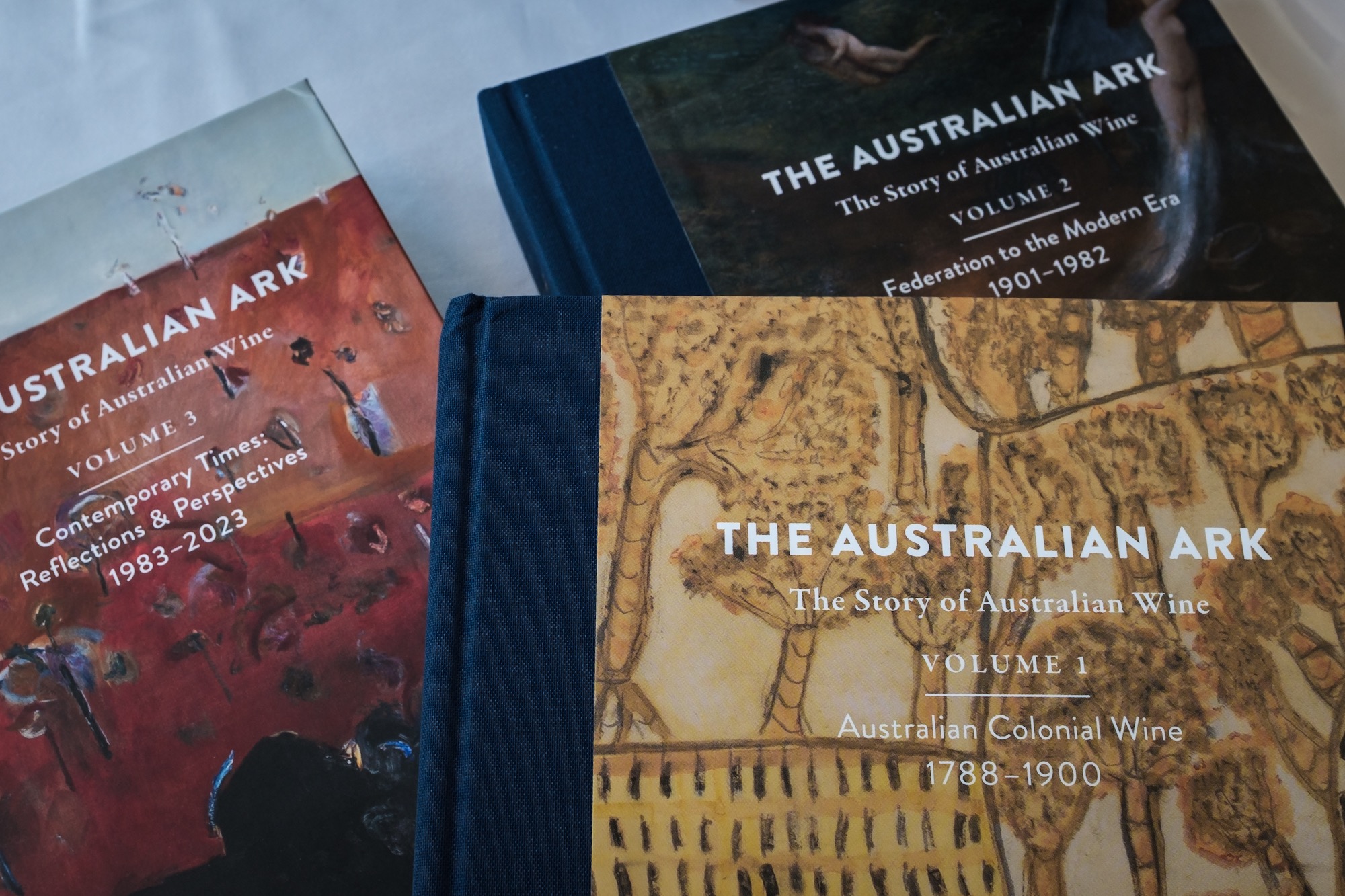
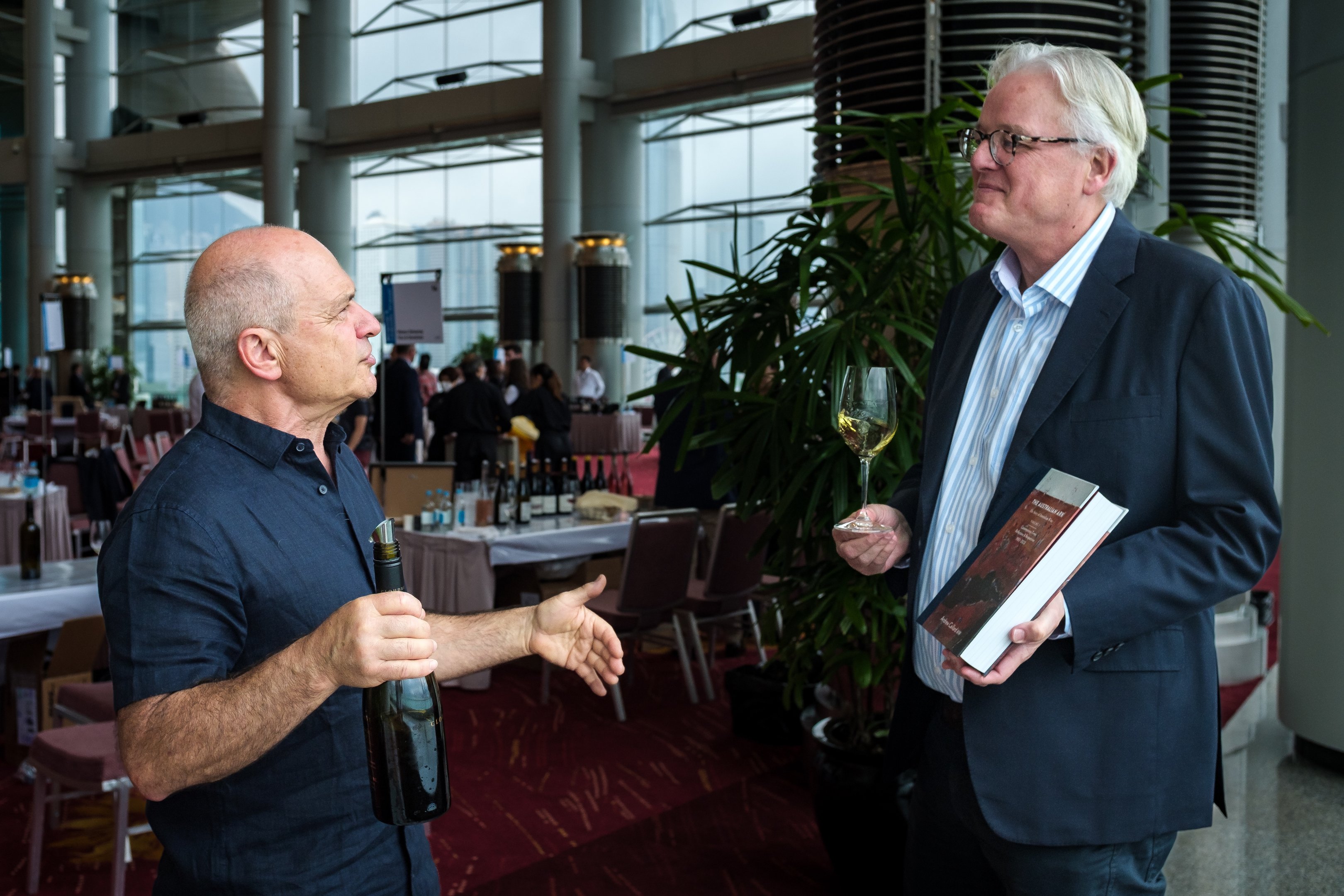
Livets Goda was at the Bettane + Desseauve Grand Tasting in Hong Kong just before the opening of VINEXPO ASIA and that’s where we got the chance to sit down and chat with the Sidney-based Master of Wine Andrew Caillard, who was there to show his latest opus, 3 splendid volumes about the history of Australian wine: The Australian Ark.
Could you please introduce your latest work, The Australian Ark, to people who have not heard of it?
It’s the history of Australia through the prism of wine. There are probably very few books like that. It’s the most intensive publication ever done on the history of Australian wine. And although I’m the author, an editor is always a useful thing, so I’ve had editors and I’ve even had historians going over my material. There’s a lot of early colonial Australian history and then also the story of the Aboriginal First Nations people and you need to get that right because it’s very sensitive at the moment. I also worked with archivists, as we saw something like 20,000 images. We’ve had to sift through all those images, and we’ve landed up with something like 1,300 in the book itself. So the work behind the publishing process has been phenomenal and that’s why it cost so much money to produce, a normal publisher wouldn’t touch it.
How long did the making of this project take you?I started 18 years ago.
I guess you didn’t think it would be of this scope at the time.
No, not at all.
I was going to be doing something completely different. There was a book written by a very famous vigneron called Dr. Max Lake who wrote a beautiful small book called Classic Wines of Australia. He was a friend of my grandmother who was a collector of wine and she was also a part owner of one of South Australia’s oldest wineries called Chateau Reynella.
And so, I had this feeling of romance with Australian wine, and I thought I might update his book. I started doing that and I’d got up to about 15,000 or 16,000 words, so not very much, but still sufficient enough -this would be about 25% of a book or more. But then the business that I was working with, Langton’s, was acquired by a supermarket group called Woolworths -I knew my world was going to change, so I ditched it.
And then in the meantime I wrote a few other books like Penfolds’ The Rewards of Patience and did a whole lot of history and all that kind of stuff. And so about eight years ago, I started going back into the book using all of that material. So the original book is actually integrated into the Australian Ark as the canon of Australian wine.
It lists all the very top wines or important wines produced from 1792 to the present day.
It was one of those projects that was kind of a marathon and I never really thought about the end point for quite some time. I just plugged away at it whenever I was on a plane, or at home on holiday. I became a really boring person because I wouldn’t go out for lunch or dinner, I’m a painter and I wouldn’t paint, just like a dog with a bone without even knowing when it was finished.
Then during COVID, I was able to get it to completion. By that time it was 350,000 words. And I got talking to another wine writer about it, I was telling him how frustrated I was because I had a publisher in the UK, but they wanted to produce it as one book and I wanted to produce it as three. And I also wanted to have it of a particular quality, and he said, well, why don’t we do it together? And so that was what we did. And then a few weeks later I sent an email to a whole lot of people in the wine industry, friends and family, with the perspectives about what the book was and said: ”it’s been written, it’s the draft, but we need to go through the publishing process and this is how much it’s going to cost.”
And we managed to raise with the first emailing, for 22 emails, 320,000 Australian dollars. And then over the period of the next six months we raised another 300,000 dollars. And we needed to do that because with the tariffs, the 212% tariffs that China put on, never could we publish it and print it in China.
And so the costs went up by about 250,000 dollars. So in the end it was a million-dollar project, and that was a not-for-profit project so there were no author’s fees. I’ve done it purely for vocational reasons.
The only money I’ll get back is the money I put into it. I put in some money to overcome a funding gap because I didn’t want to deal with any banks and also some of my travel expenses and stuff like that, which I’ve covered for now.
The wine industry has been magnificent in its response. Fellow wine writers, and Australia’s most famous wine writer, James Halliday, wrote me a text, and he said, “it’s a triumph”, and a few people called it a masterpiece and all that kind of stuff. I’ve been in this milieu now for six months with all this kind of thing, so I can now say it without emotion, but it’s been pretty amazing. It is something that’s never been written before and it just tells such a romantic story about Australia. In the 19th century, you know, observers in France, some of the most famous scientists in England and elsewhere believed that Australia would become France in the Southern Hemisphere.
And that’s what everyone believed in. And there were some beautiful old wines made and there was this huge export market boom in the 1870s, 1880s, right until the First World War. Then after the First World War, there was a thing called the Export Bounty Act, which encouraged winemakers to pivot from making table wines to fortified wines.
And all people can remember about Australian wine and export markets is our cheap fortified wines and not the great, wonderful wines that we were producing in the late 1800s. So it’s a really fascinating story and it’s so emotional. There’s one picture which is on page 9 in volume 2, which really gets me, you know, makes me tearful.
It’s a picture of 10 young boys in front of a cart of grapes that have just been picked from a vineyard in the foothills of the Adelaide Hills. And there’s some older men there as well. But one of these people is a guy called Hurtle Walker, he’s a young man and he became a very famous winemaker after the First World War. But out of those 10 people, he was only one of two or three boys that actually came back from the First World War alive. So there were a lot of young men who had this extraordinary future for them in wine in Australia and what Australia could have been. But the First World War destroyed all those hopes and ambitions. And my great-grandfather was one of them. He was killed at Gallipoli in 1915.
I feel very emotional about what it took for the Australian wine industry to develop and I’m very proud of what was achieved. I just love the story of Australian wine.
But you were actually born in the UK, weren’t you?
Yes, I was born in Cambridge in the UK but my mother’s Australian.
My father was a serving Royal Air Force officer who retired as an Air Vice-Marshal and then they came back to live in Australia. But in my mother’s family, her mother, Lydia Reynell, was a very well-known hostess and she was a vigneron, well, part vigneron, because she partly owned Chateau Reynella and she had a marvellous palate as well.
Her family were some of the early pioneers of winemaking in South Australia. They arrived two years after the foundation of the province of South Australia in 1838, and they established a winery, Reynella, named after the family. They were called the Rinells and the town’s called Reynella. However, over the years, because a lot of my family were killed in the First and Second World War, the family lost control of the winery. It went into corporate hands and a lot of the land was sold off to become housing because it’s quite close to Adelaide.
All there is now is just the winery, the old cellars and stuff like that, but the vineyards have all gone. Urbanisation has literally taken away all the vineyards.
In the days when my grandmother lived and my mother grew up, during the war, the vineyards and the land spread all the way down to the sea.
Just to come back to something you said… The community of wine-writers and such in Australia, they supported you and your effort in the end, there wasn’t too much of a sense of competition?
No, it’s really fascinating. The Australian Ark has just brought out this extraordinary, overwhelming avalanche of support. And nothing but well-done praise. It’s been absolutely phenomenal. Every major wine writer in Australia, a couple not, but almost all of them, have sent me a note to congratulate me on what has been achieved. And that’s astonishing.
As if they saw the bigger scope of things and understood this was important.
Yes, they did. They saw it’s a generous thing.
And also, I’ve written something that they can use, to be able to help them write more interesting articles and stuff like that. But it’s been incredible, absolutely incredible.
You somehow have just created the reference for years to come. And usually this is appreciated many years later, in retrospect, but it seems people have understood the momentum of it.
They have, the writers have. I don’t think the wine industry, not all the wine industry has. But there’s a very famous winemaker called Brian Croser who established the Petaluma brand and now has the Tapanappa brand – he’s now in his late 70s or even in his early 80s – who came to the launch of the book, came up to me and said: “Andrew, people will not realise what you have done for two or three years. It’s something that’s very difficult to absorb until you’ve seen it, you’ve read through it and you understand what it is. But don’t be disheartened by it. It’s a great achievement.” And, you know, I wrote it not for commercial reasons, but because I felt that the next generation needed to understand where Australia came from because that’s the only way in which, as an industry we will know how to shape our future. And I think that if this book can help the wine industry do that, then its purpose has been achieved. And that’s the reason why the book is dedicated to the next generation.
I wrote the book principally for the wine industry and their families. That was my thinking behind it.
And we didn’t mention the title, but I find it wonderful.
You know, one of the things about the Australian Ark was the publisher in the UK said they didn’t like that name. And I thought, oh, it’s been months and months trying to find a word for it, a name for it. And it’s not an original title, but I really like it because everything that came out to Australia, the vine stock, the people, you know, it’s a Western culture. We came to this strange land and everything came by boat, a bit like the Ark in the Bible. The animals going two by two and all the kind of plants and plant material as well so that when the flood subsided, you know, you had all the materials and the germ plasm to start the world again.
The Arch also gives an idea of a sprawling story, though spelled differently.
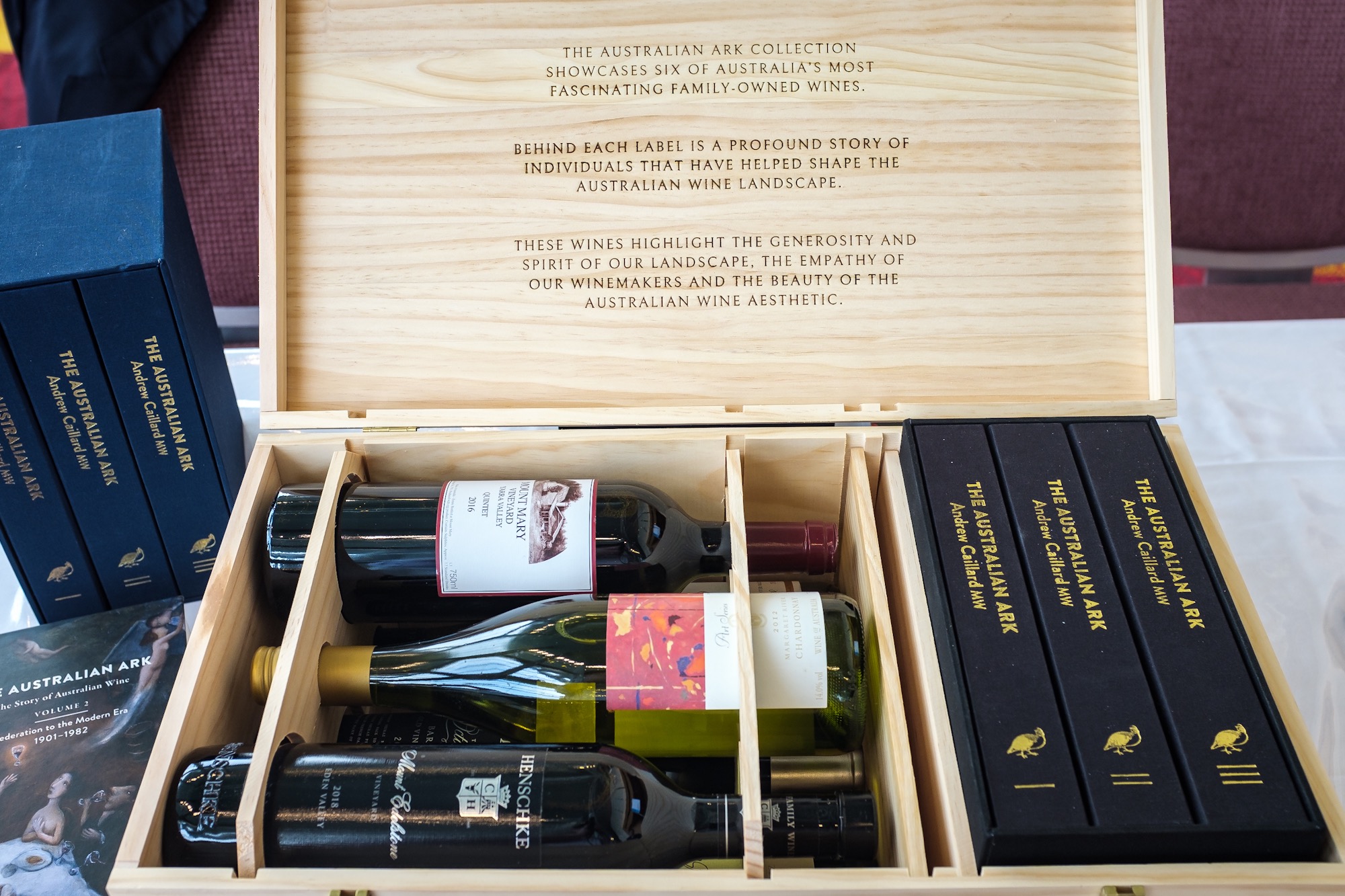
And the symbol on the books, it is a stylised version of my family crest: it’s a quail because Caillard comes from the word quail in French.
Do you have any bedside table wine? Like a bedside table book, a companion wine that you go back to regularly as a trusted friend for company?
There are. And, you know, I often go back to wines that are just easy to drink and they’re not serious wines.
I want wines that I can just knock back without thinking too much about them. And there’s a whole range of them, but, you know, Australian wines, things like Wynn’s Black Label Cabernet Sauvignon from Coonawarra, Cirillo Grenache or Yalumba Grenache.
I really like their warm climate, you know, like Pinot Noir and they’re delicious. I love the Margaret River Chardonnays and I often drink those like Vasse Felix, not the really expensive ones, but the less expensive ones, Voyager Estates, Howard Park…
Out of Australia, I get some Frescobaldi, Nipozzano, I was buying that because I thought it was delicious and such good value.
You know, taxes in Australia are a fairly big thing and Guigal Côtes du Rhône or Chapoutier Côtes du Rhône. I like wines that are not overly expensive and easy to drink and gluggable and those are my go-to wines. And if the truth be known, I almost enjoy them more than fine wine.
It’s a funny thing because fine wine you’re always having to intellectualise stuff. I’ll always get as a thing for me, champagne.I love drinking champagne. It’s absolutely delicious, but I will not intellectualise champagne. For me, I just want to drink it and whip it down and enjoy it.
I don’t need and I don’t care about all the other stuff. So it makes me a bit of a Luddite, but I do just love the enjoyment of champagne. It’s one of my favourite drinks.
You just touched upon something I was going to ask you, has the fact that you now have the coveted title of Master of Wine changed your appreciation of simple wines, of these easy drinking wines?
No, not at all. And I think in the end, it’s also what’s really interesting. Getting the MW was a very humbling experience for me. I found it very difficult to walk around with the, with the moniker because, you know, they always say you’ve got to feel like a master of wine when you take the exam.
And I did, but I found the whole thing overwhelming. I passed over 30 years ago now. And as a writer of wine, I’m more interested in the people and their motivations, and the landscapes, as I’m a painter. I love all the feelings and the relationships and the emotions and all that kind of stuff.
And so for me, I do believe in the cause of fine wine, absolutely. And I’m very much involved in it. But, you know, there is a simple enjoyment of beautifully made Cotes du Rhone or wines that are made for early drinking.I like those type of wines.
And conversely, the very, very top end, with the marketing spin and the exclusivity and everything, I don’t really like it very much.
It doesn’t appeal to me at all. Nor the way the people talk, the way they posture and make out that they’re some form of gods. I just don’t like that.
For me it’s about the shared experience. What’s the point of making a wine that’s so exclusive that few people can ever afford to buy them? You know, I have been very privileged to buy, to enjoy wines like Domaine de la Romanée-Conti or whatever. But I’ve also experienced the most beautiful wines with the worst people you could possibly imagine to be with.
For me, the shared experience is about the people you’re sharing with. They’re just as important as the wine itself. And I can enjoy a very basic wine with as much, you know, enjoyment as the greatest wine ever produced.
What are the current developments or trends in winemaking or in the industry that you are excited about? Well, I’m excited about climate change, actually. I’m excited about all the issues that are associated with climate change and the mitigation of climate change and all the things that have been done in the vineyard, which all lead into this idea: sustainable wine growing, zero emissions, solar energy, AI, autonomous vehicles and all of that kind of stuff. I’m really genuinely excited by that because because the wine industry is magnificent in the way it’s reacting to this challenge, not of our generation, but also the next generations for years, for generations to come: we’ve got to learn to live on this land by giving back more than we take out. And this is a very, very important thing. For me, fine wine has to be a sustainable product. And if it’s not, it cannot be called a fine wine anymore. It is absolutely preposterous to believe that you can make a fine wine without having that essence of being a farmer and taking care of the custodianship of the land. Thankfully, I can say that the wine industry in Australia and beyond, in France and Italy, Spain, everywhere, everyone’s on board. You know, some are a bit slow, some a bit ahead of the curve but everyone’s going in that direction because, for humanity’s sake, everyone knows that’s what we need to do for the wine industry.The other thing I’m less excited about is the the development of the “No-Low” category because I think there’s a lot of rubbish that goes around the “No-low” category. A lot of it is not a sustainable product, the energy that’s made into making you go through the whole process of fermentation and then you go through the process of de-alcoholisation… I’m just thinking why do we have to bother with this?Can we develop something that tastes like wine and is low alcohol? Absolutely, but alcohol is a very important part of vinosity and you know what? You don’t have to drink wine every day. I don’t and I don’t choose to drink low alcohol or no alcohol wine when I’m not drinking wine. I drink water and water is the most beautiful drink you can possibly drink.
A last question, for our audience in Sweden. Have you ever had a chance to try any of the Swedish wines? No, I haven’t tried them and it’s really because I’m at the other end of the world and I just haven’t had any exposure to them. I judge in wine shows international competitions and that’s when I get to see wines from Mexico and Thailand and all these places not well-known for wine but I know that with the climate change, I see what’s happening in the UK, England particularly with sparkling wine and light table wines. So obviously Sweden must be in the same position so I look forward to the day when I actually end up tasting one.BUT I have to say that my MWship as they like to call it, I could not have done it without a very good Swedish entrepreneur and wine collector called Anders Josefsson..
He was the largest collector of Grange Hermitage and one of the early pioneers of collectable Australian wine. He was a magnificent person and he had left Sweden to come and live in Australia because he loved all the nature and he brought his young family. He’s one of the reasons why I was able to get the Master of Wine qualification because he served me all these incredible wines from all over the world. He had an extraordinary, amazing collection, so I think of him very fondly.
He had a wonderful estate up in New South Wales and he needed things to be valued and I ended up going and valuing his cellar and then becoming a friend of his and we did a whole lot of things together, it was just fantastic.
But that was a long time ago, when I was still in my late 20s and early 30s. He died in his 70s but he’d be in his 80s now and I am 64.
That’s someone I always acknowledge in everything I do because he was such a magnificent supporter.
The Australian Ark: The story of Australian wine
500,000 words | 1760 pages | 1100 images
Andrew Caillard MWPublished by Longueville Media and The Vintage Journal
Volume 1: 1788–1900, The Colonial Era
Volume 2: 1901–1983, Federation to the Modern Era
Volume 3: 1983–present day, Contemporary Times – Recollections and Perspectives